Snowflake vs Star Schema: Differences, Performance & Use Cases
Understand the difference between star schema vs snowflake schema, performance, examples, and when to use each in data warehouse design.
Star Schema
Snowflake Schema
Side-by-Side Technical Matrix
Direct evaluation across performance, complexity, latency, and data modeling parameters.
| Evaluation Criterion | Star Schema | Snowflake Schema |
|---|---|---|
| Structure | Simple, flat | Complex, normalized |
| Joins | Fewer joins | More joins |
| Query Performance | Faster | Slower |
| Storage | More redundancy | Less redundancy |
| Complexity | Easy to understand | Harder to design |
| Use Case | BI dashboards | Complex enterprise systems |
Core Concepts & Architecture Workflows
Foundational definition, data flow patterns, and architectural mechanics for each system.
What is Star Schema?
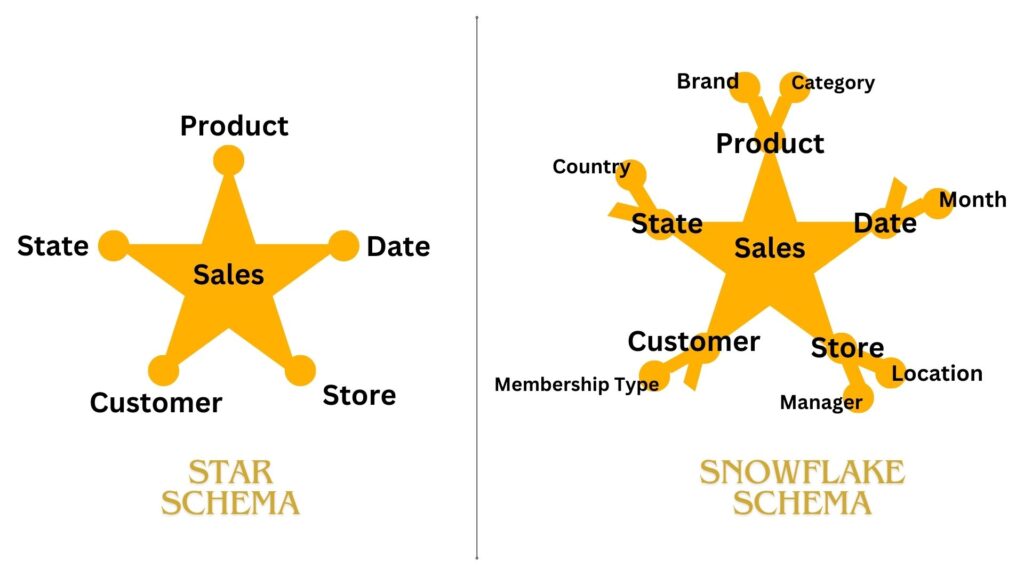
Paradigm AA Star Schema is a simple data warehouse design where:
- A central fact table connects directly to denormalized dimension tables
- Structure looks like a star
Key Idea 👉 Fewer joins → Faster queries
What is Snowflake Schema?
Paradigm BA Snowflake Schema is a more complex design where:
- Dimension tables are normalized into multiple related tables
- Structure looks like a snowflake
Key Idea 👉 More structure → Less redundancy
Real-World Implementation, Queries & Architecture Code
Concrete SQL queries and pipeline implementation patterns.
Example of Star vs Snowflake Schema
Star Schema Example - Fact Table: Sales - Dimensions: - Customer - Product - Date - Region
Snowflake Schema Example - Product → Category → Department - Customer → City → State → Country
Example Code: Star vs Snowflake Schema
Understanding the difference between Star Schema vs Snowflake Schema becomes much clearer with SQL examples.
Star Schema Example (Fewer Joins 🚀)
In a Star Schema, dimension tables are directly connected to the fact table.
SELECT
    c.customer_name,
    p.product_name,
    SUM(f.sales_amount) AS total_sales
FROM fact_sales f
JOIN dim_customer c ON f.customer_id = c.customer_id
JOIN dim_product p ON f.product_id = p.product_id
GROUP BY c.customer_name, p.product_name;
👉 Why it's fast?
- Only 2 joins
- Denormalized tables
- Optimized for analytics queries
Snowflake Schema Example (More Joins ❄️)
In a Snowflake Schema, dimension tables are normalized into multiple tables.
SELECT
    c.customer_name,
    p.product_name,
    cat.category_name,
    SUM(f.sales_amount) AS total_sales
FROM fact_sales f
JOIN dim_customer c ON f.customer_id = c.customer_id
JOIN dim_product p ON f.product_id = p.product_id
JOIN dim_category cat ON p.category_id = cat.category_id
GROUP BY c.customer_name, p.product_name, cat.category_name;
👉 Why it's slower?
- More joins required
- Normalized structure
- Better for storage, not speed
Key Takeaway
- Star Schema → Simpler queries, faster execution
- Snowflake Schema → Complex queries, more joins
👉 In real-world data engineering, query simplicity = performance
Performance of Star vs Snowflake Schema
Real-world throughput, latency constraints, and operational cost trade-offs.
When to Use Star vs Snowflake Schema
Guidelines for selecting the optimal architecture based on system requirements.
Use Star Schema when: - You need fast query performance - Building dashboards or reports - Simpler data model is preferred
Use Snowflake Schema when: - Storage optimization is important - Data is highly structured - Avoiding redundancy is critical
Common Mistakes (Very Important 🚨)
Avoid costly anti-patterns, misconfigurations, and system design oversights.
❌ Using Snowflake Schema Unnecessarily - Adds complexity - Slows down queries
❌ Over-Normalization - Too many joins = poor performance - Hard to debug and maintain
👉 Rule: If you are building analytics → Start with Star Schema
Interview Angle (Must Know 🔥)
Essential questions and key talking points frequently asked in staff/senior interviews.
💡 1. What is the difference between Star and Snowflake Schema?
+💡 2. Which schema performs better?
+💡 3. When would you use Snowflake Schema?
+💡 4. Why is Star Schema widely used in BI tools?
+FAQ
Direct answers to common architecture queries.
❓ What is Star Schema in simple terms?
+❓ What is Snowflake Schema in data warehouse?
+❓ Which is better: Star or Snowflake Schema?
+❓ Why is Snowflake Schema rarely used?
+Key Architectural Summary
Quick recap of primary characteristics and core takeaways.