Airflow Architecture – Scheduler, Executor, Webserver & Workers
Think of Apache Airflow as a well-oiled machine. Every part of this machine has a role to play, and understanding these roles is crucial to managing complex workflows efficiently. Let’s take a journey through Airflow’s architecture to see how it orchestrates tasks behind the scenes.
Core Components of Airflow
Airflow consists of several key components that work together to manage, schedule, and execute workflows:
1. Scheduler
The Scheduler is the brain of Airflow’s timing system. Its job is to:
- Monitor DAG definitions.
- Identify which tasks need to run.
- Trigger task execution according to their schedule.
Think of the Scheduler as a meticulous planner that ensures each task starts exactly when it should, handling dependencies automatically.
2. Executor
The Executor determines how and where tasks run. Airflow supports multiple executors depending on your scale:
- SequentialExecutor: Runs tasks one at a time (good for testing or small workflows).
- LocalExecutor: Runs tasks in parallel on a single machine.
- CeleryExecutor: Distributes tasks across multiple worker machines for scalability.
- KubernetesExecutor: Runs tasks as pods in a Kubernetes cluster for dynamic scaling.
The Executor is like the dispatcher, sending tasks to the right workers efficiently.
3. Webserver
The Webserver provides a visual interface for users to:
- Monitor DAGs and task progress.
- View logs and debug errors.
- Trigger DAGs manually.
It’s Airflow’s control panel, giving engineers real-time visibility into their pipelines.
4. Workers
Workers are the engines that actually perform the work:
- Execute tasks sent by the Scheduler via the Executor.
- Can scale horizontally depending on workflow demands.
- Handle retries and task execution independently.
5. Metastore (Database)
The Metastore is the central database that stores all Airflow metadata:
- DAG definitions
- Task status and history
- Logs and variables
- Connections and configurations
It’s the memory of Airflow, keeping track of everything needed to maintain consistent workflow execution.
How Components Work Together
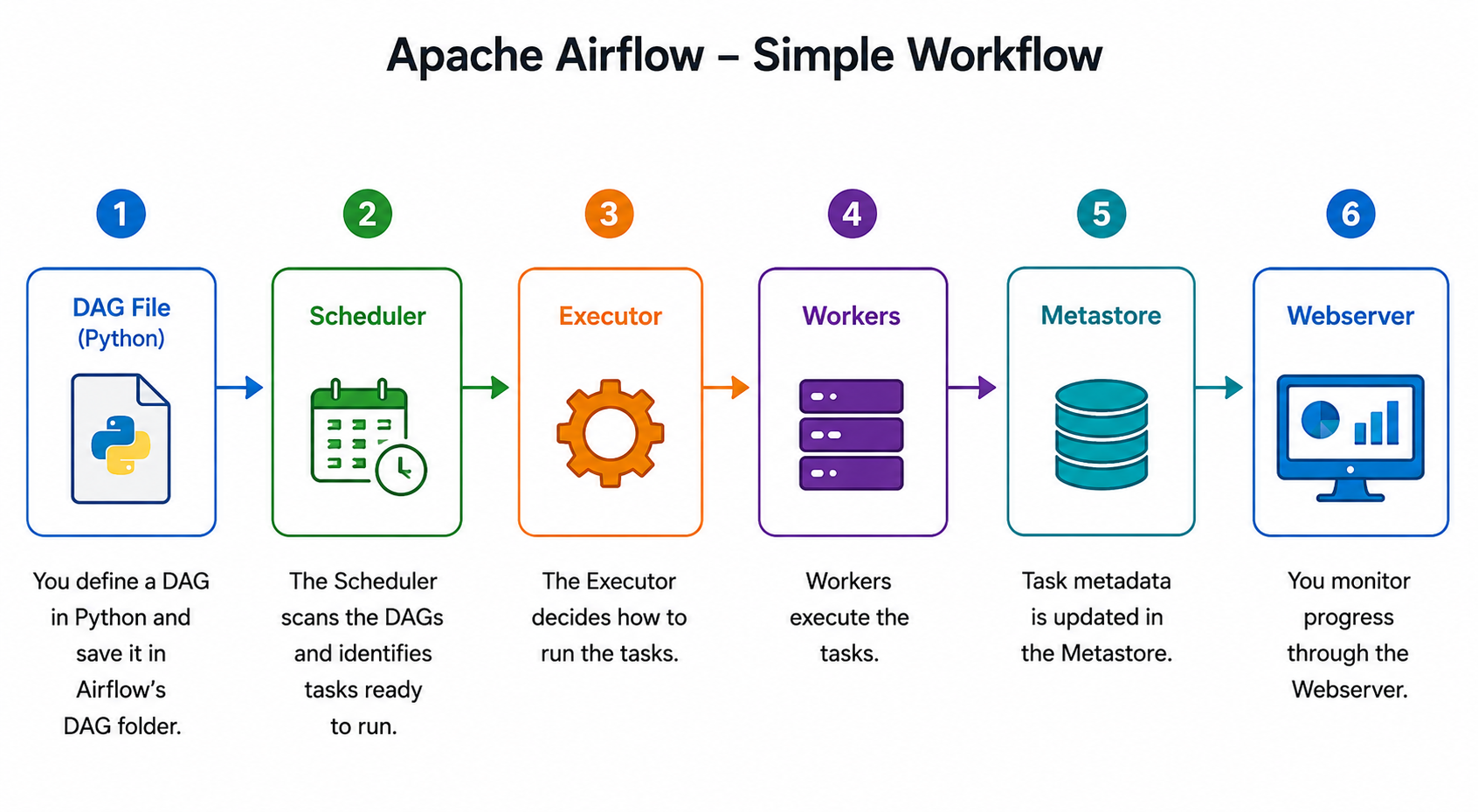
Here’s a simplified workflow:
- You define a DAG in Python and save it in Airflow’s DAG folder.
- The Scheduler scans the DAGs and identifies tasks ready to run.
- The Executor decides how to run the tasks.
- Workers execute the tasks.
- Task metadata is updated in the Metastore.
- You monitor progress through the Webserver.
Inputs and Outputs
| Component | Input | Output |
|---|---|---|
| Scheduler | DAG definitions, task states | Task execution schedule |
| Executor | Task execution requests | Task assignment to workers |
| Worker | Task from executor | Completed task result |
| Metastore | Task events, DAG info | Task history & workflow state |
| Webserver | Metadata from Metastore | Interactive UI for monitoring |
Final Thoughts
Understanding Airflow’s architecture is like understanding the engine of a high-performance car. Each component—Scheduler, Executor, Webserver, Workers, and Metastore—plays a critical role in ensuring your workflows run smoothly and efficiently. By separating responsibilities:
- The Scheduler keeps everything on time.
- The Executor decides where and how tasks run.
- Workers carry out the heavy lifting.
- The Metastore remembers everything.
- The Webserver provides real-time insights.
This modular design gives Airflow its scalability, reliability, and flexibility, allowing data engineers to focus on building pipelines rather than manually orchestrating tasks.
Summary
Airflow’s architecture is designed for flexible, scalable, and reliable workflow orchestration. By separating scheduling, execution, and monitoring, it allows teams to manage complex pipelines efficiently, scale horizontally, and maintain full visibility of workflow health.
Next Up: Understanding DAGs – Directed Acyclic Graph Concept