Incremental Load vs Full Load
If you don’t understand Incremental Load vs Full Load, you don’t understand efficient data pipelines.
👉 This decision impacts:
- Pipeline performance
- Cost
- Data freshness
What is Full Load?
Full Load means:
- Load the entire dataset every time
- Replace or overwrite existing data
Examples
- Initial data migration
- Small datasets
Key Idea
👉 Simple but inefficient at scale
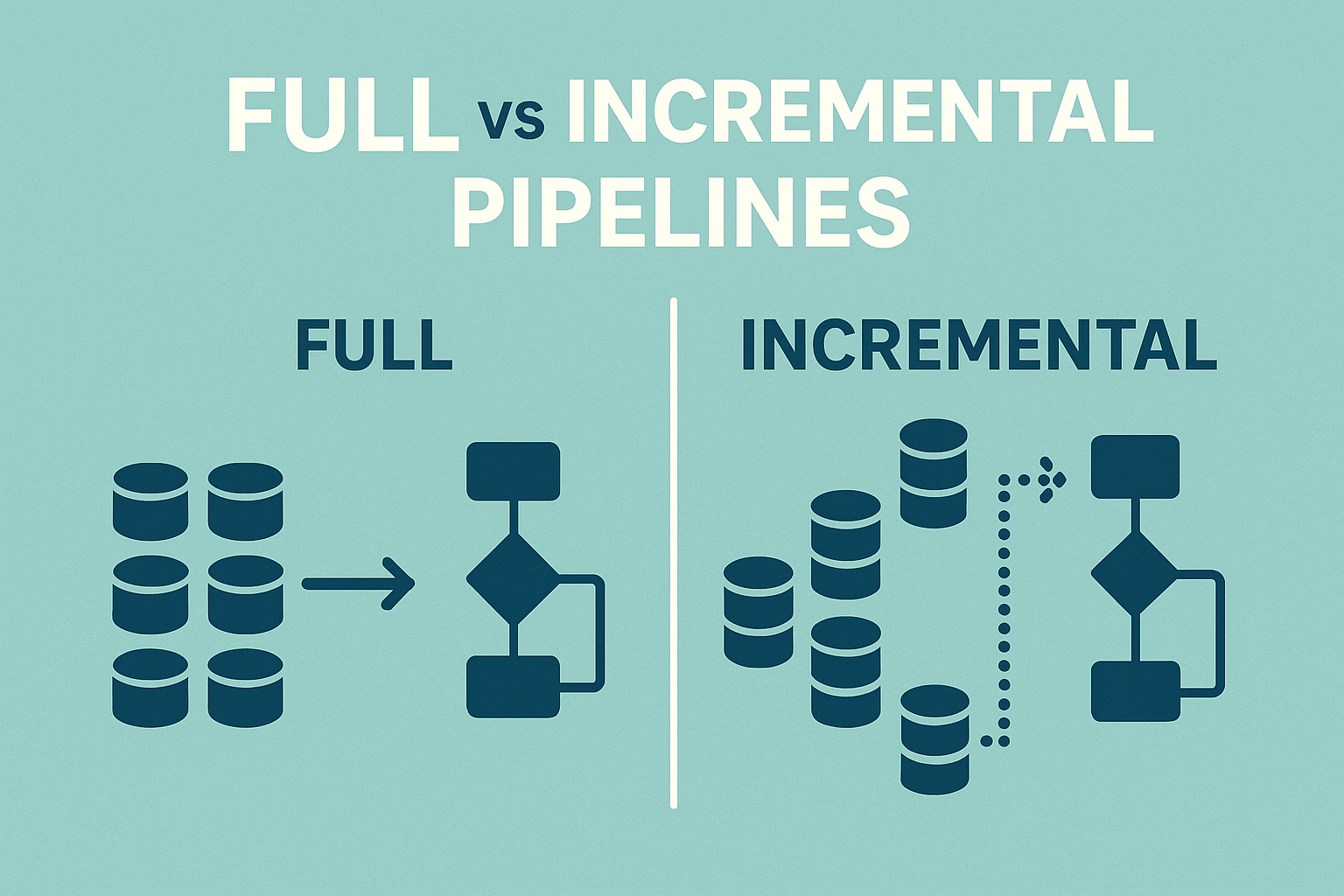
Full Load Flow
Source → Extract All Data → Overwrite Target
What is Incremental Load?
Incremental Load means:
- Load only new or changed data
- Append or update existing records
Examples
- Daily new records
- Updated transactions
Key Idea
👉 Efficient and scalable
Incremental Flow
Source → Filter New/Changed Data → Append/Update Target
Incremental vs Full Load (7 Real Differences)
| Feature | Full Load | Incremental Load |
|---|---|---|
| Data Processed | Entire dataset | Only new/changed data |
| Performance | Slow | Fast |
| Cost | High | Low |
| Complexity | Simple | Moderate |
| Data Freshness | Low | High |
| Scalability | Poor | Excellent |
| Use Case | Initial load | Regular updates |
Data Modeling: Incremental vs Full Load (Critical 🔥)
Full Load Modeling
-
Simple overwrite logic
-
No need to track changes
-
Works well for:
- Small tables
- Static data
👉 Example:
- Reload entire product table daily
Incremental Load Modeling
-
Requires:
- Timestamp column
- Change tracking
-
Often uses:
- Append logic
- Upsert (merge)
👉 Example:
- Load only records where
updated_at > last_run_time
Visual Comparison
Example Code (Real-World)
Full Load Example
-- Overwrite entire table
INSERT OVERWRITE TABLE sales_target
SELECT * FROM sales_source;
Incremental Load Example (Timestamp Based)
SELECT *
FROM sales_source
WHERE updated_at > '2026-01-01';
Incremental Upsert Example
MERGE INTO sales_target t
USING sales_source s
ON t.id = s.id
WHEN MATCHED THEN UPDATE SET *
WHEN NOT MATCHED THEN INSERT *;
Performance Reality (No BS 🚨)
Full Load
- Heavy data movement
- High compute cost
- Not scalable
Incremental Load
- Minimal data processing
- Efficient pipelines
- Scales easily
👉 Reality: Incremental is the default in production systems
When to Use Incremental vs Full Load
Use Full Load when:
- Initial data ingestion
- Small datasets
- Simplicity is priority
Use Incremental Load when:
- Large datasets
- Frequent updates
- Cost optimization needed
Common Mistakes 🚨
❌ Using Full Load for Large Tables
- High cost
- Slow pipelines
❌ Incorrect Incremental Logic
- Missing data
- Duplicate records
❌ Not Handling Updates Properly
- Leads to inconsistent data
Interview Angle 🔥
Must-Know Questions
1. Difference between incremental and full load?
👉 Full = all data
👉 Incremental = only changes
2. How do you implement incremental load?
👉 Using timestamps or IDs
3. Which is better?
👉 Incremental for large data
4. Is incremental same as CDC?
👉 No (CDC tracks all changes, incremental may not track deletes)
Compare Data Engineering Concepts
FAQ
What is incremental load?
Loading only new or changed data.
What is full load?
Reloading the entire dataset.
Which is better incremental or full load?
Incremental is better for large datasets.
Is incremental same as CDC?
No, CDC captures inserts, updates, and deletes.
Comparison Cards
Full Load
- Loads all data
- Simple logic
- High cost
- Not scalable
Incremental Load
- Loads only changes
- Efficient pipelines
- Low cost
- Highly scalable
Final Summary
- Full Load = Simple but heavy 📦
- Incremental Load = Efficient and scalable ⚡
👉 Real-world systems use:
- Full Load → Initial
- Incremental → Ongoing